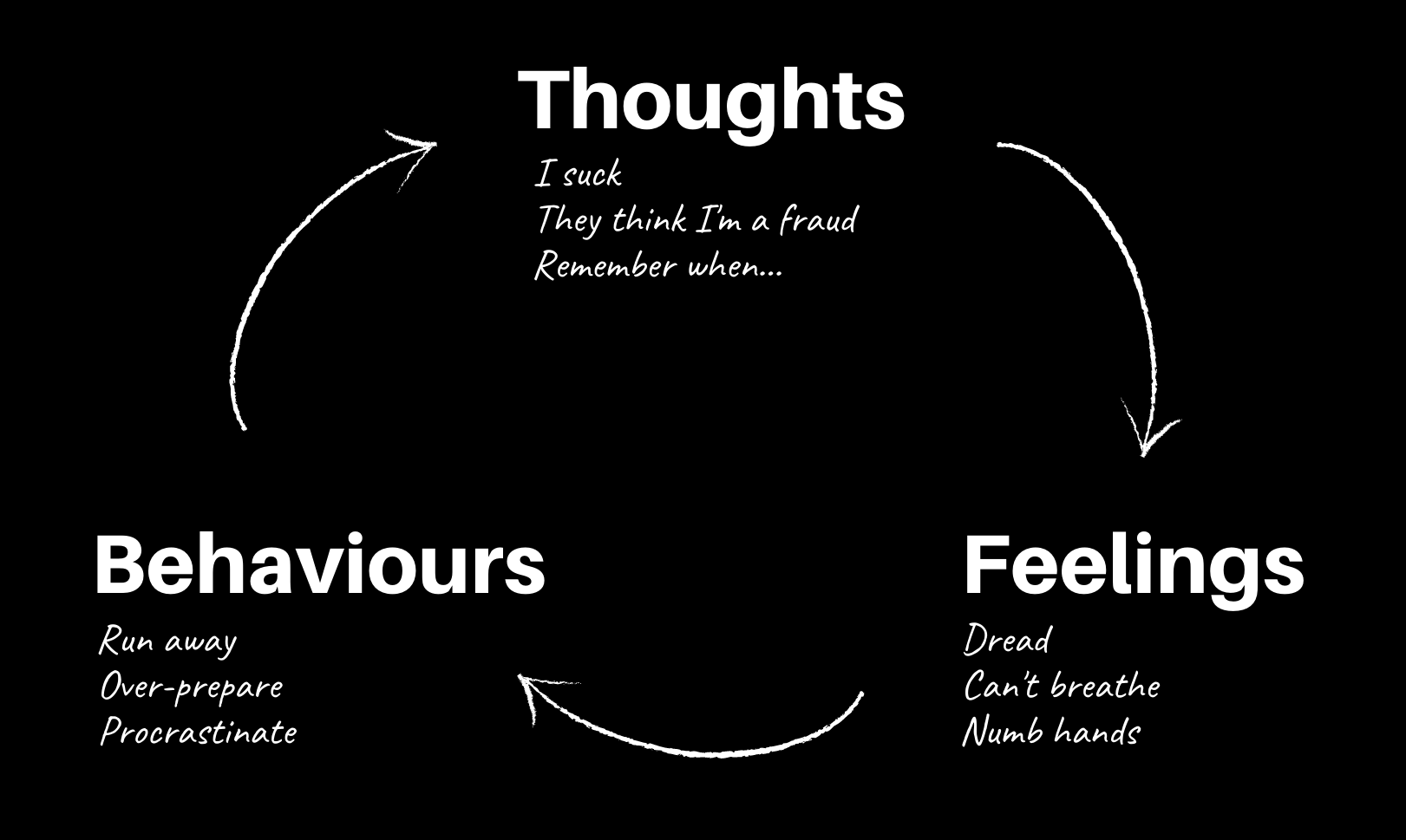
CBT Triangle
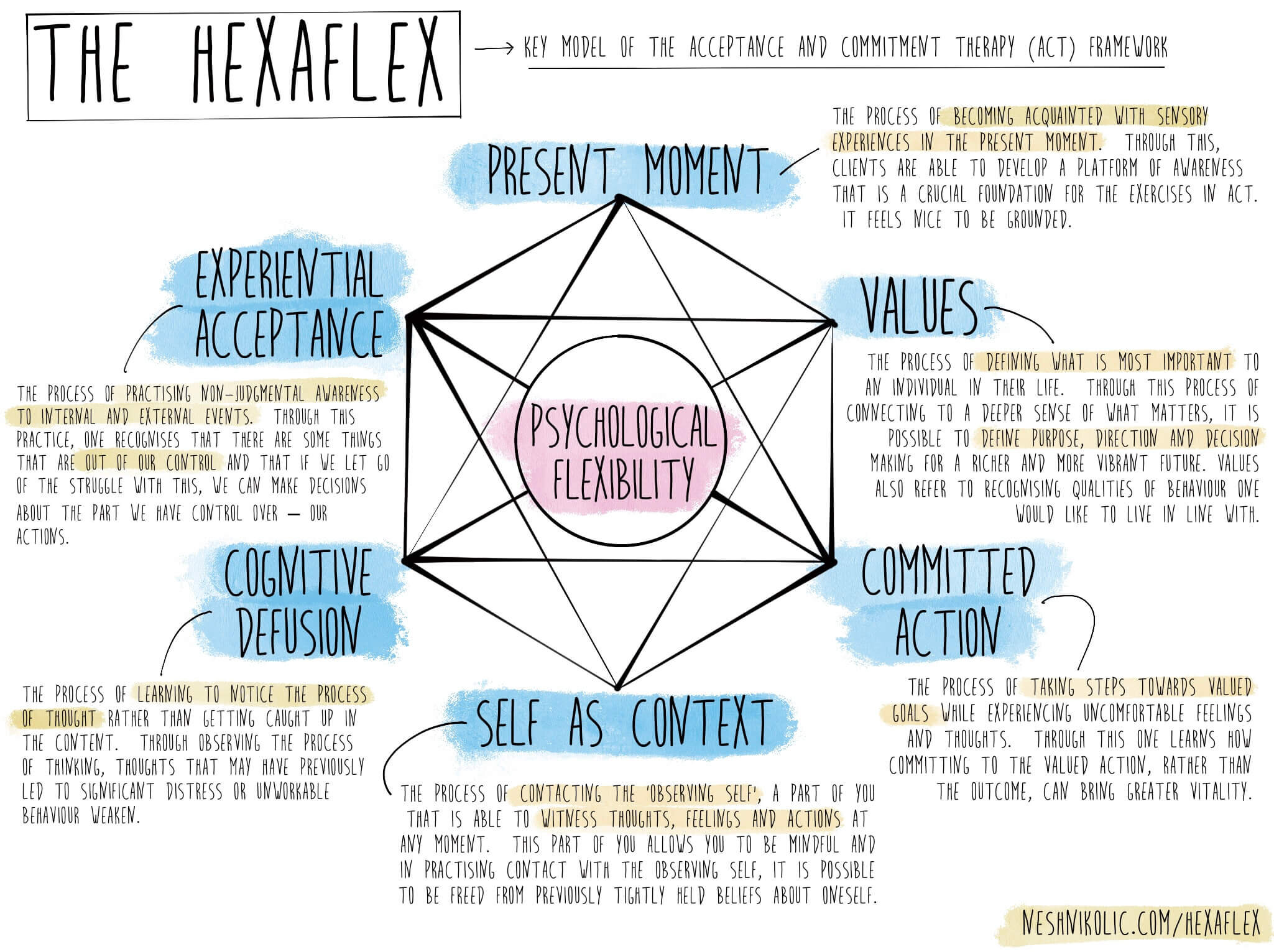
ACT Hexaflex Copilot
ACT stands for Acceptance and Commitment Therapy, which is a third-wave Cognitive-Behavioral Therapy (CBT) that incorporates mindfulness1. The Hexaflex model is a hexagonally shaped visual aid used in ACT to classify and treat client problems holistically1. It consists of six core processes that correspond to the core ACT principles1:
-
Present Moment: ACT is a present-moment-focused therapy. The purpose of this focus on the present moment is to restore a sense of control lost in many clients seeking therapy or coaching1. ACT practitioners believe you cannot control anything except your behavior1
-
Acceptance: Acceptance is taught as an alternative to experiential avoidance. Acceptance involves the active and aware embrace of those private events occasioned by one’s history without unnecessary attempts to change their frequency or form2.
-
Values: ACT allows therapists to include the client’s values into the clinical or coaching work, ensuring that clients feel connected to and invested in the work1.
-
Cognitive Defusion: Cognitive defusion techniques attempt to alter the undesirable functions of thoughts and other private events, rather than trying to alter their form, frequency or situational sensitivity2.
-
Self-as-Context: ACT promotes ongoing non-judgmental contact with psychological and environmental events as they occur2.
-
Committed Action: ACT is all about helping clients cultivate psychological flexibility. The points of the hexaflex represent the six aspects of psychological flexibility1. It is a person’s ability to change their thinking and behavior when it is not serving them1.
Each of these six domains corresponds to one of the core ACT principles, all of which have various activities and exercises to help the practitioner push their clients along1. The goal of ACT is to increase psychological flexibility — the ability to contact the present moment more fully as a conscious human being, and to change or persist in behavior when doing so serves valued ends2.
ACT Hexaflex
The Happiness Trap Evolution of the Human Mind Video
The human mind’s evolution to prioritize safety and survival leads to modern psychological suffering patterns.
Mindfulness
- Present moment awareness
- On purpose
- Without judgment
- Jon Kabat-Zinn
- Mindfulness Every Day Video Below
- Look into “10% Happier App”
Mindfulness Exercises
- Breathing
- Outside
- Conversation
- Eating
The Struggle Switch - By Dr. Russ Harris Video
Learn ACT with Russ Harris | Psychwire
ONE SENTENCE SUMMARY
Struggling with emotions amplifies them, but turning off the struggle switch allows for easier acceptance.
MAIN POINTS
- Struggling with anxiety amplifies emotions and leads to more negative feelings.
- The struggle switch magnifies emotions like anger, sadness, and guilt.
- Amplified emotions can lead to self-defeating behaviors and feeling bogged down.
- Turning off the struggle switch allows emotions to move freely without amplification.
- Without struggling, anxiety can fluctuate naturally without getting bigger or stickier.
- Investing time in meaningful activities instead of struggling with emotions is beneficial.
- Accepting anxiety without struggling makes it easier to live with.
- The struggle switch can be turned off by choosing not to invest energy in struggling.
- Emotions have less impact and influence when the struggle switch is off.
- Everyone experiences anxiety, but how we deal with it affects its impact on our lives.
TAKEAWAYS
- Accepting emotions without struggling reduces their impact.
- Investing time in meaningful activities can help manage emotions effectively.
- Turning off the struggle switch allows emotions to move freely and naturally.
- Struggling with emotions amplifies them and leads to negative feelings.
- Dealing with anxiety without struggling makes it easier to live with.
Cognitive Difusion
- Negative thoughts - trying to protect us
- Brain doesn’t like uncertainty, makes predictions
- Mind is a thought machine
- Thoughts are based on our history
- Doesn’t mean thtey are true/real
- Fused or sticky thoughts
Cognitive Difusion
Taking the power away from words or ideas by leaning into them
The Stageshow Metaphor Video
Life is like a stage show where the observing self can shift focus to what matters most.
Mindfulness Everyday Life Video
Renowned scientist Jon Kabat-Zinn discusses mindfulness as a gateway to being fully human and living a meaningful life.
Values
- What do you want for your kids?
- What kind of parents do you want to be?
Summary
Open
- Acceptance
- Diffusion
Centered
- Contact with Present Moment
- Self as content
Engaged
- Values
- Committed Action
PPRC Parent Graduate
- Consequences are motivations
- Things like chores and responsibilities send a message “You are not sick” or “You can still do things”
Pain Behavior Into Focus
This is very relevant to managing pain behavior, removing it from the spotlight